- All
- Product Name
- Product Keyword
- Product Model
- Product Summary
- Product Description
- Multi Field Search

Views: 0 Author: Site Editor Publish Time: 2026-11-18 Origin: Site
Power outages rarely announce themselves. One moment, the lights are humming along; the next, a hallway is pitch black, and dozens of people are trying to find an exit by feel. Office towers, hospitals, warehouses, and retail stores all rely on backup lighting to turn that chaotic first minute into a calm, orderly walk to safety.
Most facility managers already know they need emergency fixtures installed. Fewer have asked the harder question: how do you know your system will actually work the night the power goes out? Bulbs die quietly. Batteries lose capacity without warning. A unit that passed its last inspection can fail silently for months before anyone notices, because these fixtures only prove themselves during an actual blackout, or a deliberate test.
This is where the conversation needs to shift. Choosing the right emergency light fixtures matters, but choosing a system that tells you when something's wrong, before an inspector or an emergency does, matters more. That's the angle worth exploring: not just what backup lighting looks like, but how modern monitoring technology closes the gap between "installed" and "actually working."
Fire codes and workplace safety regulations require commercial buildings to maintain working backup illumination along escape routes. That's the baseline. The real purpose runs deeper: people under stress move faster and more safely when the path forward is obvious.
A well-placed Emergency Exit Sign does more than satisfy an inspector's checklist. It becomes the single visual cue that tells occupants which direction leads outside, even when smoke has cut visibility to a few feet. Clear, consistent lighting shortens evacuation time, which directly affects injury rates during fires, earthquakes, or electrical failures.
The trouble is that most backup lighting failures aren't discovered through use. They're discovered, if they're discovered at all, during a routine walk-through: a dim bulb here, a dead battery there, a unit that was quietly dark for the past three months. Since these fixtures only activate when mains power drops, nobody notices a failed unit until someone tests it on purpose, or until it's needed and isn't there.
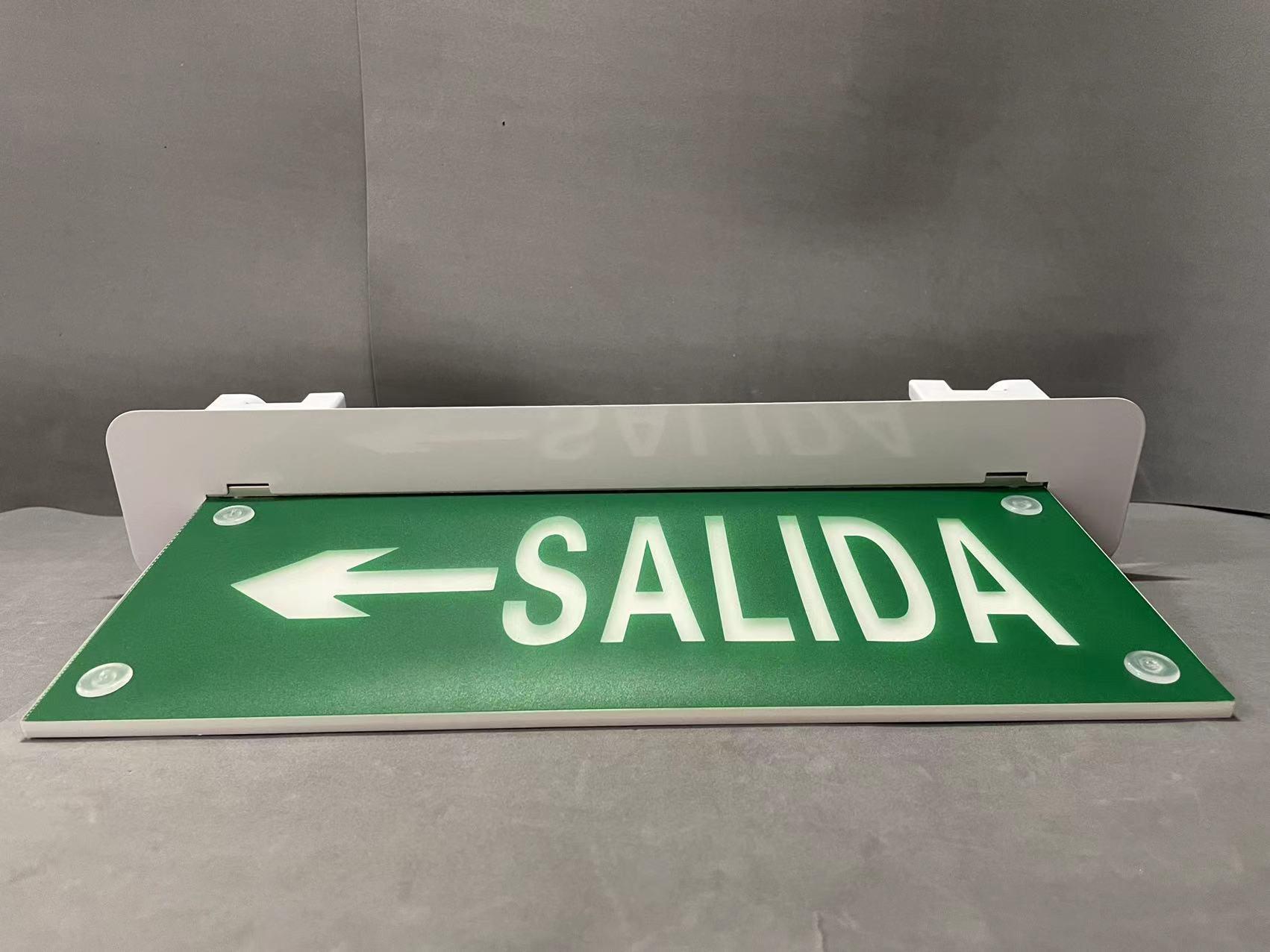
Commercial buildings typically combine several fixture categories to cover their full footprint:
Exit sign fixtures mark escape routes near doors and corridors.
Twin-spot units throw directional beams across open floor areas and stairwells.
Ceiling and downlight fixtures blend into finished interiors like offices and retail spaces.
Bulkhead lights handle damp or exposed zones such as parking garages and loading docks.
Wall-mounted lights cover narrow corridors and secondary exits.
Choosing the right combination depends on layout, ceiling height, and the specific hazards present in each zone. A reliable LED emergency light setup pairs these fixtures with either a self-contained battery or a central battery system, so illumination activates automatically within seconds of an outage.
Fixture Type | Typical Use Case | Power Source |
|---|---|---|
Exit Sign Fixture | Marking escape routes near doors and corridors | Battery backup / mains |
Twin-Spot Unit | Open floor areas, stairwells, large rooms | Self-contained battery |
Ceiling & Downlight | Finished interiors, offices, retail spaces | Central battery system |
Bulkhead Light | Garages, warehouses, damp or exposed areas | Self-contained battery |
Wall-Mounted Light | Narrow corridors and secondary exits | Battery backup |
That table covers the hardware. What it doesn't show is how any of these units get checked once they're on the ceiling, which is where most backup lighting plans quietly fall apart.
Here's a scenario that plays out in buildings everywhere: a facilities team installs a solid mix of fixtures, passes the initial inspection, and moves on to the next project. Eighteen months later, a surprise outage reveals that four units along a main stairwell never lit up. Nobody had walked that corridor with a test switch since the install.
This isn't a hardware problem. It's a visibility problem. Most codes require monthly functional checks and an annual full-duration test under simulated outage conditions, and keeping a maintenance log isn't optional in most jurisdictions, it's something inspectors will ask to see. But manual testing depends on someone remembering to do it, building by building, floor by floor, fixture by fixture.
Intelligent, centrally monitored emergency lighting systems close that gap. Instead of a technician walking every corridor with a checklist, every fixture reports back to a central control panel: battery health, lamp status, test cycle results, all visible from one screen. If a unit along an escape route starts to fail, the system flags it immediately rather than waiting for the next scheduled walk-through or, worse, the next real emergency.
For a facility with dozens or hundreds of fixtures spread across multiple floors, that shift changes the entire maintenance equation. Instead of asking "did someone check unit 47 this month?" the question becomes "is there a fault flagged anywhere in the building right now?" One is a hope. The other is a fact you can verify in seconds.
Selection should start with occupancy type and maintenance capacity, not brand preference. A hospital has different continuous-lighting requirements than a small retail shop, so runtime and brightness needs will vary significantly.
Choose a self-contained system if your building is smaller, your fixture count is manageable, and your team has the bandwidth to physically check each unit on schedule. These systems are simpler to install and don't require a central panel.
Choose a centrally monitored system if your facility spans multiple floors, has limited maintenance staff relative to its fixture count, or houses continuous-occupancy spaces like hospitals where a single undetected failure carries outsized risk. The upfront setup is more involved, but it replaces guesswork with a dashboard, and it turns a compliance obligation into something closer to a smoke detector that actually tells you when the battery's low.
Certification should factor into either choice. Fixtures carrying ISO and CE marks have been tested against recognized safety and performance standards, which matters when insurers or regulators review compliance documentation after an incident.
Backup lighting isn't something most people think about until the power actually goes out, and by then, it's too late to fix a dark corridor. The deeper issue isn't usually whether a building has fixtures installed. It's whether anyone actually knows those fixtures are working right now, today, without walking the building floor by floor.
Reviewing fixture placement is step one. Reviewing how those fixtures get tested, and whether failures get flagged automatically or discovered by accident, is the step most buildings skip. Facility managers planning an upgrade should weigh centralized monitoring seriously, not as a luxury add-on, but as the feature that actually closes the gap between "compliant on paper" and "ready for the next outage."
Meta title
Emergency Lighting: Why Monitoring Matters More Than Fixtures
Meta description
Learn why centrally monitored LED emergency light systems catch failures before an inspection, or an emergency, ever does.
When the lights go out unexpectedly, the first few seconds decide whether an evacuation stays calm or turns chaotic. Office towers, warehouses, hospitals, and retail stores all depend on backup illumination to guide people toward safety the moment a power failure hits. Without it, hallways and stairwells become disorienting, and panic can set in fast.
This is where properly installed backup fixtures earn their keep. A reliable emergency exit sign does more than meet a building code checklist — it becomes the visual anchor that tells occupants exactly which direction leads outside, even through smoke or darkness. Building managers who treat these fixtures as an afterthought often discover the gap only during an actual emergency, which is the worst possible time to find out a unit has failed.
Fire codes and occupational safety regulations in most countries require commercial buildings to maintain functioning backup illumination along escape routes. But compliance is really just the baseline. The deeper purpose is behavioral: people under stress move faster and more safely when the path forward is obvious. Clear, consistent lighting reduces the time it takes to clear a building, which directly affects injury rates during fires, earthquakes, or electrical failures.
Facilities with outdated or poorly maintained systems frequently discover problems during routine inspections — dim bulbs, dead batteries, or units that simply never switch on. Since these fixtures only activate during an actual power loss, their failures can go unnoticed for months unless someone tests them deliberately.
Commercial buildings typically combine a few different categories of fixtures to cover their full footprint. Twin-spot units illuminate open areas and stairwells with directional beams, ceiling-mounted and downlight versions blend into finished spaces without looking industrial, and bulkhead fixtures handle damp or exposed locations like parking garages and loading docks. Choosing the right mix depends on the building's layout, ceiling height, and the specific hazards present in each zone.
A dependable LED emergency light setup usually pairs these fixtures with a central battery or self-contained backup power, so illumination kicks in automatically within seconds of an outage. Newer intelligent systems take this further by linking every fixture to a central control panel, allowing facility managers to monitor battery health and test cycles remotely instead of inspecting each unit by hand.
Fixture Type | Typical Use Case | Power Source |
|---|---|---|
Exit Sign Fixture | Marking escape routes near doors and corridors | Battery backup / mains |
Twin-Spot Unit | Open floor areas, stairwells, large rooms | Self-contained battery |
Ceiling & Downlight | Finished interiors, offices, retail spaces | Central battery system |
Bulkhead Light | Garages, warehouses, damp or exposed areas | Self-contained battery |
Wall-Mounted Light | Narrow corridors and secondary exits | Battery backup |
Selection should start with occupancy type. A hospital has different continuous-lighting requirements than a small retail shop, so the runtime and brightness levels needed will vary significantly. Facility managers should also weigh whether a self-contained unit (battery built into each fixture) or a centralized system (one battery bank powering multiple fixtures) suits their maintenance capacity better. Self-contained units are simpler to install, while centralized systems reduce the number of individual batteries that need periodic replacement.
Certification matters just as much as design. Fixtures that carry ISO and CE marks have been tested against recognized safety and performance standards, which matters when regulators or insurers review a building's compliance documentation after an incident.
Manufacturers with decades of production experience tend to offer more consistent battery performance and longer product lifespans. Jiangmen Yuanhe Import and Export Co., Ltd, operating under the PRO LED brand, has specialized in commercial and industrial backup lighting for more than twenty years, exporting to markets worldwide since 2001. The company's factory runs its own SMT production and assembly lines alongside dedicated quality control teams, and its products are manufactured under ISO9001 and CE certification — details worth checking when comparing suppliers for a large-scale installation.
Installation is only the starting point. Battery-powered fixtures degrade over time, and most codes require periodic functional testing — often monthly for a quick activation check and annually for a full duration test under simulated outage conditions. Keeping a maintenance log isn't just good practice; it's frequently a legal requirement that inspectors will ask to see.
Any emergency light that fails a test should be flagged and repaired immediately rather than scheduled for "next time." A single non-functioning unit along an escape route can create a dark gap that disorients occupants exactly when clarity matters most. Facilities using intelligent, centrally monitored systems have an advantage here, since battery faults and lamp failures are flagged automatically rather than discovered during a manual walk-through.
Backup lighting isn't something most people think about until the power actually goes out — and by then, it's too late to fix a gap in coverage. Reviewing fixture placement, battery health, and compliance documentation now, rather than after an inspection flags a problem, is the difference between a building that handles an outage smoothly and one that doesn't. Facility managers planning an upgrade or a new installation should evaluate certified, well-tested equipment and build a maintenance schedule around it from day one.


